How Many Keywords Per 1000 Words? (The Ultimate Keyword Density Guide)
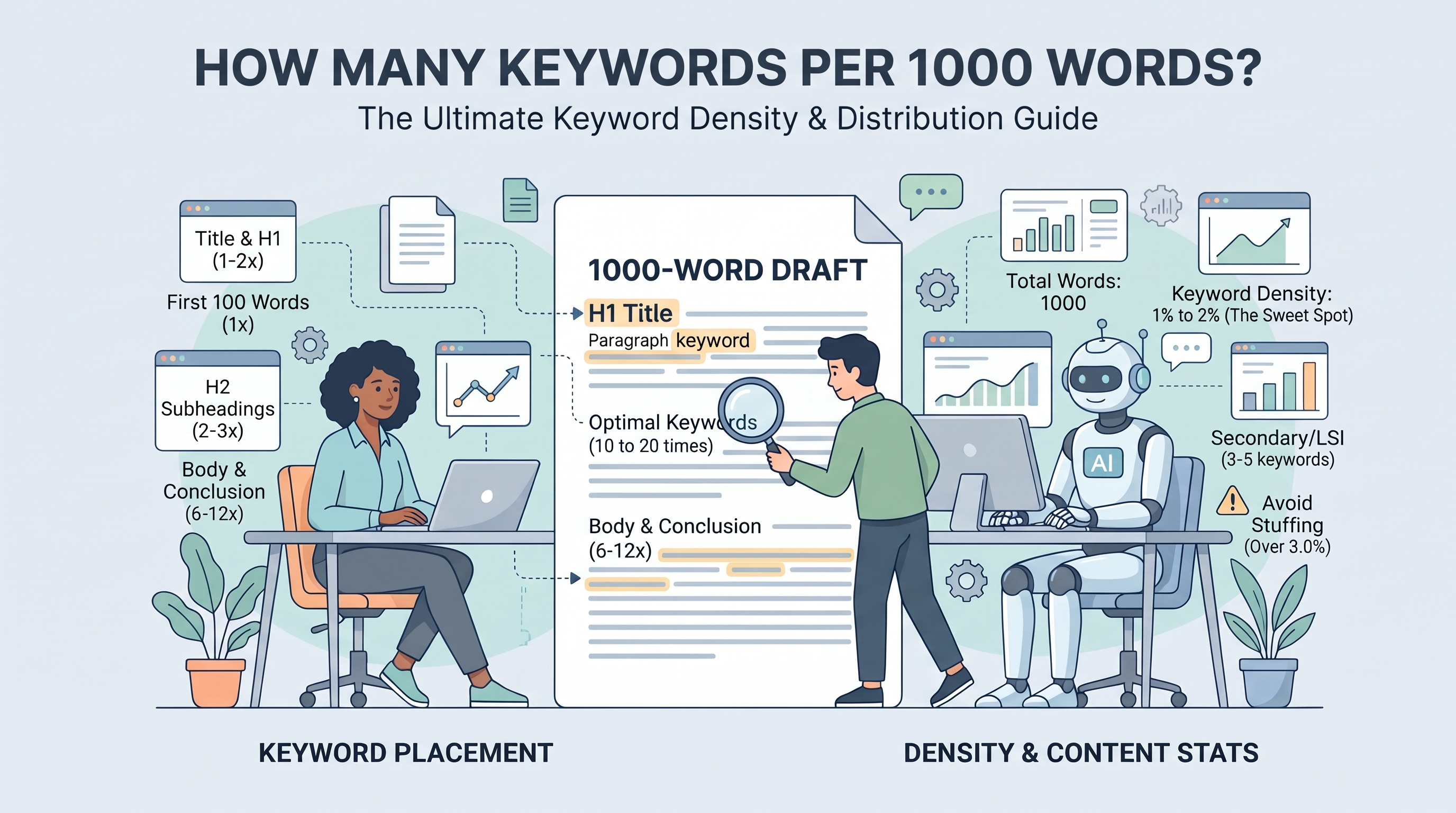
If you are writing a 1,000-word article, the general rule of thumb for keyword density is 1% to 2%. This means your primary target keyword should appear 10 to 20 times throughout the text.
However, in 2026, blindly chasing a mathematical percentage is one of the fastest ways to ruin your content's readability and trigger Google's spam filters. Modern search engines use advanced Natural Language Processing (NLP) to understand context, synonyms, and search intent rather than just counting how many times a specific phrase appears on a page.
In this guide, we will break down exactly how to distribute your keywords across a 1,000-word blog post, why keyword stuffing is dangerous, and how to optimize your content naturally for maximum visibility.
Table of Contents
The Short Answer: Keyword Math for 1,000 Words
Historically, SEO professionals relied heavily on Keyword Density—the percentage of times a keyword or phrase appears on a web page compared to the total number of words.
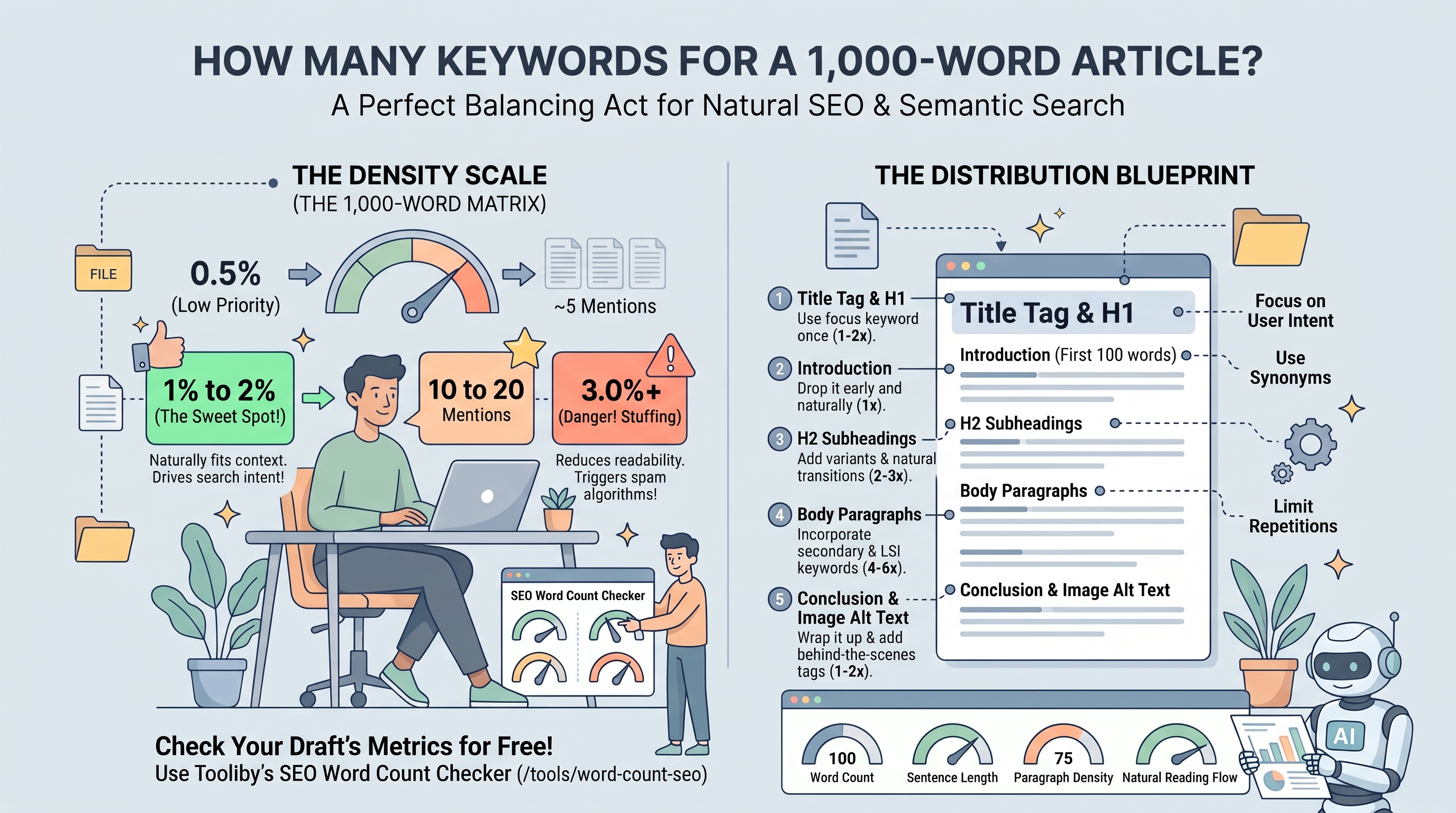
Here is the basic math for a 1,000-word blog post:
0.5% Density: 5 mentions
1.0% Density: 10 mentions (Recommended Sweet Spot)
2.0% Density: 20 mentions (Maximum Safe Limit)
3.0%+ Density: 30+ mentions (High Risk of Penalty)
If you force your primary keyword into the text 30 times, it will read unnaturally to a human audience. A high bounce rate from frustrated readers will do more damage to your ranking than a "perfect" keyword density score could ever fix.
Why Strict Keyword Density is a Thing of the Past
Ten years ago, you could rank a page simply by repeating a phrase like "best running shoes" over and over again. Today, Google's algorithm (powered by updates like Hummingbird, BERT, and modern AI overviews) is much smarter.
Google now focuses on Semantic SEO. This means the search engine understands topics, not just individual strings of text. If you are writing 1,000 words about "Apple," Google's algorithm analyzes the surrounding words to determine if you are talking about the fruit (juice, orchard, pie) or the technology company (iPhone, Mac, software).
Because of this, covering a topic comprehensively—which naturally requires a higher word count—is far more important than hitting an exact keyword frequency. (This is closely tied to
The Perfect Keyword Distribution Strategy
Instead of worrying about hitting exactly 15 mentions in your 1,000 words, focus on where you place your keywords. Strategic placement in high-impact HTML zones is much more effective than random repetition.
Here is the ideal blueprint for keyword placement in a 1,000-word guide:
The Title Tag and H1: Your primary keyword must appear in the main headline of your article.
The Introduction (First 100 Words): Place your keyword within the first paragraph to immediately confirm to the reader (and the search bot) that they are in the right place.
One or Two H2 Subheadings: Use the primary keyword (or a close variation) in your structural subheadings.
The Body Text: Mention the keyword naturally 4 to 6 times throughout the remaining 800 words.
The Conclusion: Reiterate the keyword in your final summary paragraph.
URL Slug: Keep it short and include the primary keyword (e.g.,
yourdomain.com/blog/primary-keyword).Image Alt Text: Include the keyword naturally in the description of one of your images.
LSI Keywords and Semantic Search
To avoid keyword stuffing, you should substitute your primary keyword with LSI (Latent Semantic Indexing) keywords. These are conceptually related terms that search engines use to deeply understand your content.
For example, if your primary keyword is "Digital Marketing Agency" (which you will use ~10 times in your 1,000 words), your LSI keywords might include:
SEO services
Social media management
Online advertising
Content strategy
Marketing ROI
By naturally weaving these related terms into your text, you prove your topical authority to Google without sounding repetitive. Building this kind of depth is exactly how new websites begin to effectively
How to Check Your Content Length and Density
Writing comprehensive, long-form content naturally dilutes your keyword density, making it safer from spam filters. However, you still need to ensure your content is long enough to cover the topic deeply enough to rank.
Before hitting publish, run your draft through the
This free utility does more than just count your words. It breaks your text down by sentence and paragraph density, allowing you to gauge the readability of your draft. By comparing your final word count against the top-ranking competitors for your specific keyword, you can determine if your 1,000-word article is perfectly optimized, or if the search intent demands even more depth.
Frequently Asked Questions (FAQs)
1. Is 1,000 words enough for an SEO blog post in 2026?
It depends entirely on the search intent. For a simple definition or quick answer, 500 words might be enough. For a comprehensive "How-To" guide or pillar page, 1,000 to 2,500 words is often required to outrank competitors.
2. What happens if I use my keyword too many times?
This is called "keyword stuffing." Google will likely view your page as web spam and issue a ranking penalty, dropping your page to the bottom of the search results or removing it from the index entirely.
3. Do I need to use the exact match keyword every time?
No. In fact, it is better not to. Google understands stop words and variations. If your keyword is "buy cheap shoes," writing "buy some cheap shoes" or "buying cheaper shoes" still counts and reads much more naturally.
4. How many secondary keywords should I target in a 1,000-word post?
You should ideally target 1 primary keyword and 3 to 5 secondary (LSI or long-tail) keywords. Use the secondary keywords 1 to 3 times each, primarily in your body paragraphs and H3 subheadings.
What Is Tooliby Blog?
Tooliby Blog is a free publication covering developer tools, SEO, AI prompts and productivity — written by real practitioners who use these tools daily. No paywall, no account needed. Just practical content you can act on.
Can I share this article?
Yes — use the share buttons above to post on Twitter, LinkedIn, Facebook or WhatsApp. The more people read it, the better.
How do I write for Tooliby?
Click Write for Us and submit your article. We review within 48 hours and publish with full author credit and bio.