The 80/20 Rule in SEO: Why Ranking #1 on Google Isn't Enough Anymore
For over two decades, the ultimate goal of any webmaster, marketer, or digital publisher was simple: reach the coveted #1 spot on Google's search results. But as we navigate through 2026, the search landscape has drastically shifted. With the rise of AI Overviews, zero-click searches, and rich interactive snippets, everyday marketers are asking tough questions: What is the 80/20 rule in SEO? Why isn't ranking #1 on Google enough anymore? Are backlinks still relevant? Will SEO exist in 5 years? And practically, how to rank #1 in SEO today?
If you are pouring hours into optimizing your website but seeing diminishing returns on your organic traffic, you need to change your strategy. In this comprehensive guide, we will break down the Pareto Principle in search optimization, explain why the #1 ranking doesn't guarantee traffic anymore, and reveal how to future-proof your digital real estate in the AI-search era.
[Insert Banner Image Here]
Table of Contents
What is the 80/20 Rule in SEO? (The Pareto Principle)
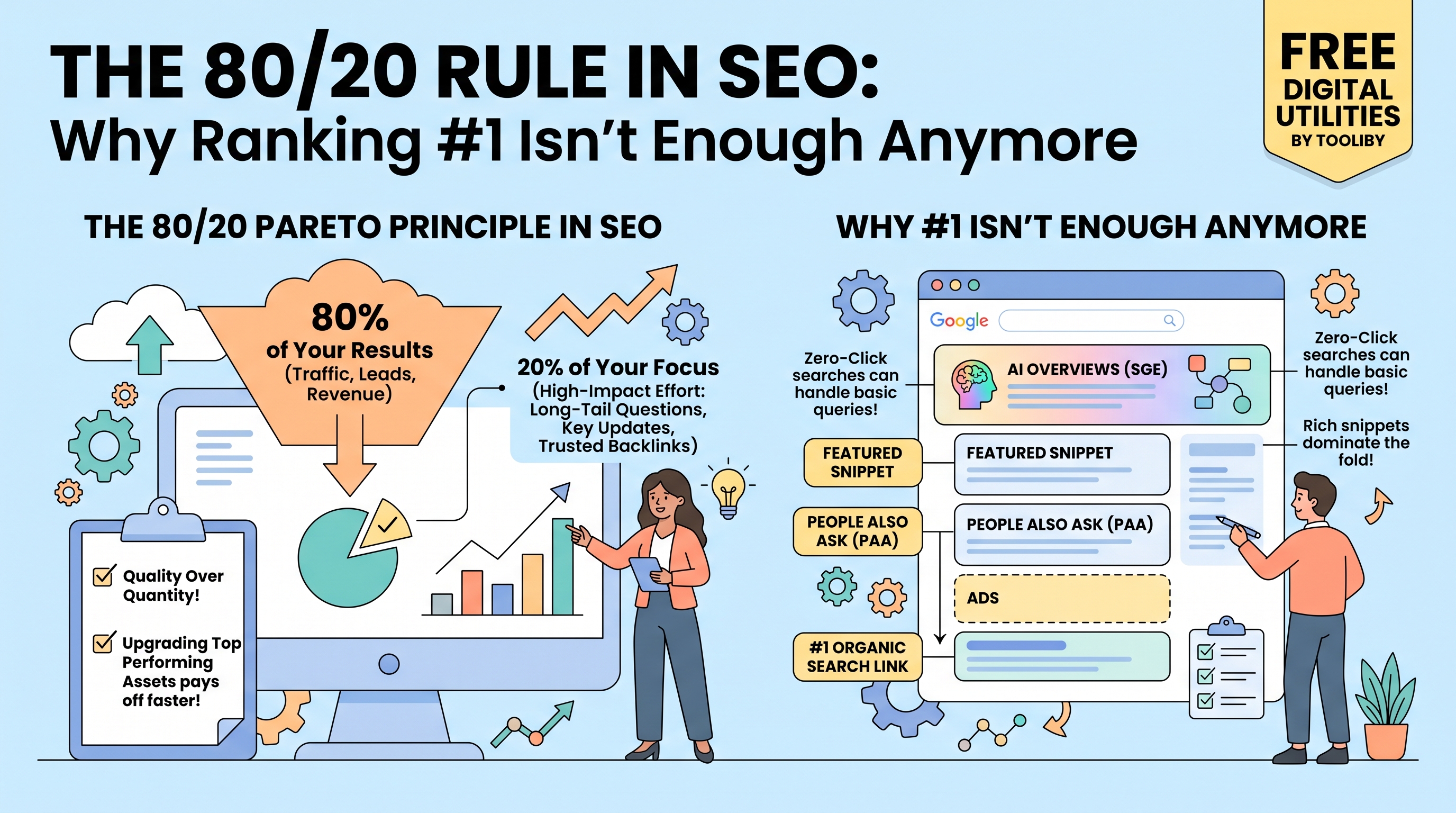
When digital marketers ask, what is the 80/20 rule in SEO?, they are referring to the application of the Pareto Principle to search engine optimization. The rule states that 80% of your results (organic traffic, leads, and revenue) will come from just 20% of your efforts.
Instead of trying to optimize hundreds of minor ranking factors, successful webmasters focus relentlessly on the high-impact 20% that actually moves the needle.
How to Apply the 80/20 Rule to Your Website
Keyword Focus: 80% of your traffic will come from 20% of your highest-converting, low-competition keywords. Stop wasting time on broad keywords you cannot rank for, and hyper-focus on specific, long-tail user questions.
Content Updates: Instead of writing 100 mediocre blog posts, focus on updating, expanding, and perfecting your top 20 best-performing articles. Adding fresh data, visual tables, and FAQs to existing content yields faster results than publishing from scratch.
Link Building: 80% of your domain trust comes from 20% of your high-quality contextual backlinks. A handful of links from authoritative, niche-relevant websites will always outperform thousands of low-quality directory links.
By applying the 80/20 rule, you stop chasing technical perfection (like agonizing over a 99 vs. 100 page-speed score) and start focusing on the elements that directly impact user experience and search intent.
Why Isn't Ranking #1 on Google Enough Anymore?
It sounds counterintuitive, but reaching the number one blue link on Google's Search Engine Results Pages (SERPs) is no longer the guarantee of traffic it used to be. Webmasters frequently ask: Why isn't ranking #1 on Google enough anymore?
The answer lies in how search engine interfaces have evolved over the last few years.
1. The Rise of Zero-Click Searches
Today, nearly half of all Google searches end without a user clicking on any website. Because Google pulls data directly from websites to display instant answers via Featured Snippets, Knowledge Panels, and local packs, users get their answers right on the search page. If your article only provides a generic answer, users have no incentive to click through to your site.
2. AI Overviews and Generative Search
With the integration of generative AI directly into search results, the traditional #1 organic spot has been pushed down below the fold. The AI Overview reads multiple top-ranking pages, summarizes them, and presents a comprehensive answer at the very top of the screen. If your content isn't cited inside the AI Overview, being the #1 traditional link might mean you are actually the 4th or 5th visual element on the screen.
3. Declining Click-Through Rates (CTR)
Because the SERPs are crowded with videos, shopping grids, "People Also Ask" drop-downs, and sponsored ads, the organic click-through rate for the #1 position has dropped significantly. To win traffic today, you don't just need the top spot—you need a magnetic meta description, a compelling title tag, and deep, original insights that AI cannot easily summarize.
[Insert Infographic Here]
How to Rank #1 in SEO: The Modern Playbook
With the rules of the game changing, the tactical approach to securing top rankings must also adapt. So, how to rank 1 in SEO in this modern, highly competitive environment?
Step 1: Establish Topical Authority
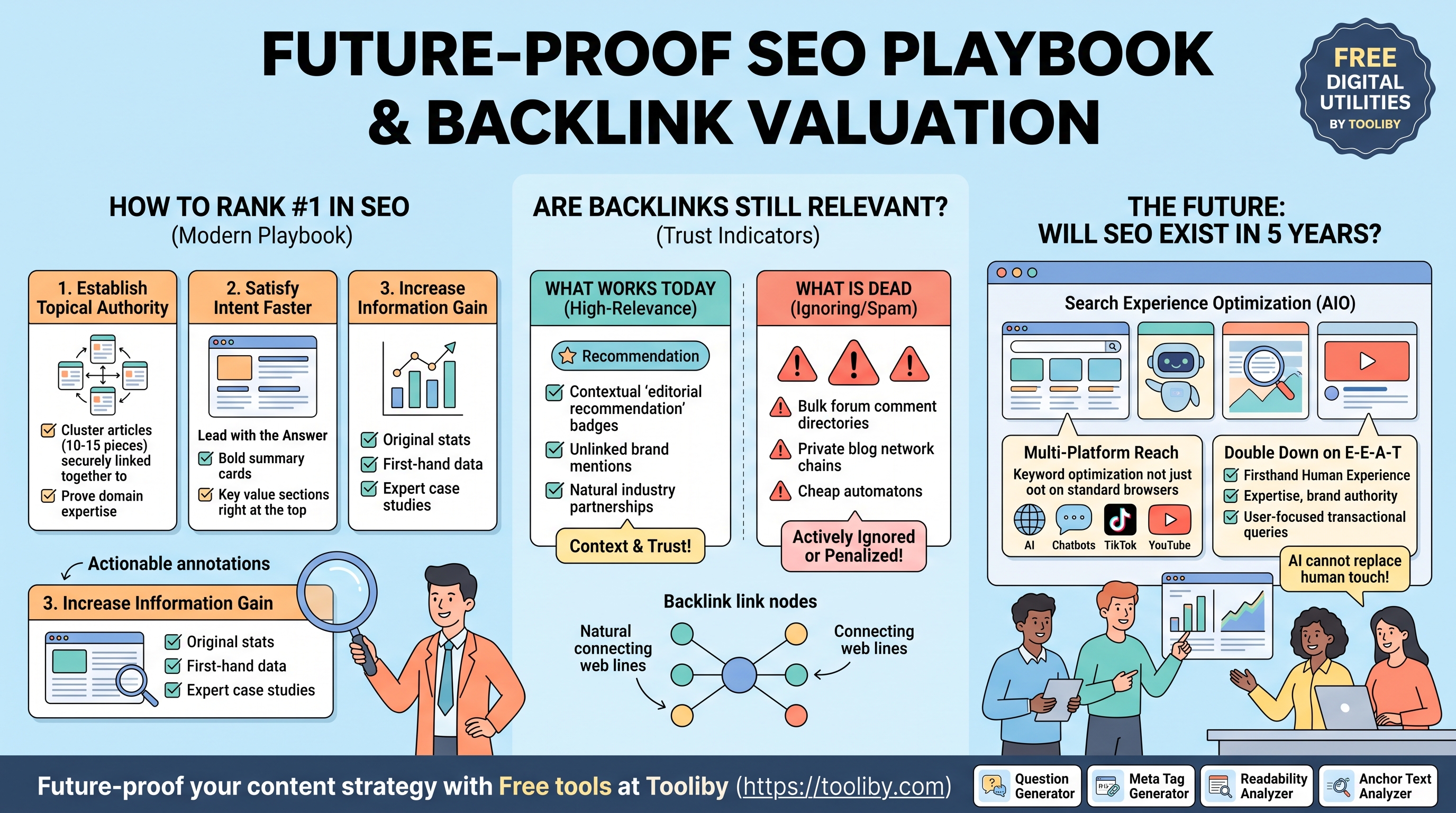
Google no longer ranks individual pages in isolation; it ranks domain expertise. If you want to rank for "best SEO audit tools," you cannot just write one article. You need a dedicated cluster of 10 to 15 interrelated articles covering every aspect of SEO audits, securely linked together. This proves to search engines that you are an industry authority, not a one-hit wonder.
Step 2: Satisfy Search Intent Faster
When a user clicks your link, they want immediate value. "Lead with the answer." Do not bury the solution to their search query beneath 500 words of fluffy introductions. Provide a clear, bolded answer or a summary table at the very top of your page. Once their intent is satisfied, they will scroll down for the deeper details.
Step 3: Optimize for the "Information Gain" Score
Google's patents suggest they use an "Information Gain" score to evaluate content. If your article says the exact same thing as the top 5 ranking articles, your information gain is zero. To rank #1, you must include original data, unique case studies, expert quotes, or custom graphics that do not exist anywhere else on the web.
Are Backlinks Still Relevant in 2026?
As AI becomes better at understanding content quality, a common question arises in the SEO community: Are backlinks still relevant?
Yes, backlinks are absolutely still relevant, but their role has matured.
In the past, Google relied heavily on backlinks as a primary vote of confidence because its algorithms struggled to understand textual context. Today, Google's Natural Language Processing (NLP) is incredibly advanced. However, backlinks remain the strongest external signal of trust.
What no longer works: Spammy blog comments, cheap Fiverr link blasts, and automated Web 2.0 links. These are actively ignored or penalized by Google's SpamBrain system.
What works today: High-relevance, contextual links. A backlink from a highly authoritative site within your exact niche serves as a digital "letter of recommendation." Furthermore, unlinked brand mentions (when authority sites talk about your brand without linking) are now treated as strong trust signals by search engines.
Will SEO Exist in 5 Years? (The Future of Search)
Given the rapid advancements in ChatGPT, Google Gemini, and AI-driven search engines, many business owners worry: Will SEO exist in 5 years?
Yes, SEO will absolutely exist in 5 years, but it will look completely different. It is evolving from "Search Engine Optimization" into "Search Experience Optimization."
The Shift to AIO (Artificial Intelligence Optimization)
In the near future, standard informational queries (e.g., "What is a URL?") will be entirely handled by AI bots. Therefore, SEOs must pivot their strategy toward topics that require human experience, opinion, and deep analysis.
To survive the next 5 years in SEO, webmasters must:
Focus on E-E-A-T: Experience, Expertise, Authoritativeness, and Trustworthiness. AI cannot demonstrate real-world, first-hand experience. Content written by verifiable human experts will hold premium value.
Target Commercial and Navigational Intent: AI is great for summarizing facts, but users still want to visit real websites to buy products, compare software, or read genuine human reviews.
Optimize for Multiple Platforms: Search is fragmenting. SEO in 5 years will mean optimizing your content not just for Google, but for TikTok search, YouTube, Amazon, and AI chatbot citations.
Future-Proof Your Content with Free Tooliby Utilities
If you want to apply the 80/20 rule to your website and capture traffic in a zero-click world, you need the right tools. You can optimize your content structure and meta-data completely free using
Find Untapped Keywords: Uncover the exact questions your audience is asking to build your topical authority using the
Question Generator Craft High-CTR Meta Tags: Combat declining click-through rates by generating compelling, clickable titles and descriptions using the
Meta Tag Generator Ensure Content Clarity: AI search bots prefer highly structured, readable text. Audit your content's flow using the
Readability Analyzer Check Internal Link Density: Pass link equity efficiently to your most important pillar pages using the
Anchor Text Analyzer
Frequently Asked Questions (FAQs)
1. What is the Pareto Principle in SEO?
It is the concept that 80% of your website's organic traffic and revenue will come from just 20% of your targeted keywords and top-performing web pages.
2. Why is my website ranking #1 but getting no traffic?
This usually happens because the keyword has a "zero-click" nature. Users are likely getting their answers directly from Google's Featured Snippets, AI Overviews, or local map packs without needing to click your link.
3. Are backlinks still a ranking factor in modern SEO?
Yes, they remain a top ranking factor. However, search engines now prioritize the quality, relevance, and contextual placement of the link over the sheer quantity of backlinks.
4. Will AI replace traditional search engines?
AI will enhance and change search engines, not replace them entirely. While AI will summarize basic facts, users will still rely on traditional websites for deep research, shopping, personal opinions, and interactive tools.
Embrace the 80/20 rule, build topical authority, and optimize your user experience effortlessly with the 360+ Free Digital Tools at
What Is Tooliby Blog?
Tooliby Blog is a free publication covering developer tools, SEO, AI prompts and productivity — written by real practitioners who use these tools daily. No paywall, no account needed. Just practical content you can act on.
Can I share this article?
Yes — use the share buttons above to post on Twitter, LinkedIn, Facebook or WhatsApp. The more people read it, the better.
How do I write for Tooliby?
Click Write for Us and submit your article. We review within 48 hours and publish with full author credit and bio.