What is the Main Purpose of a Domain? (Naming Mistakes, Best Companies & AI SEO Trends)
Starting an online business or launching a personal brand begins with one foundational step: securing the right web address. But once the website is live, the conversation quickly shifts from basic naming to a more pressing modern concern: How do we survive the age of Artificial Intelligence?
People frequently ask search engines: What is the main purpose of a domain? What should you avoid in your domain name?
Which domain is in demand? And more importantly for the future: Is SEO dead now with AI, and which 5 jobs will survive AI?
In this comprehensive guide, we bridge the gap between building your foundational digital real estate (your domain) and future-proofing your web presence in the era of generative AI.
Table of Contents
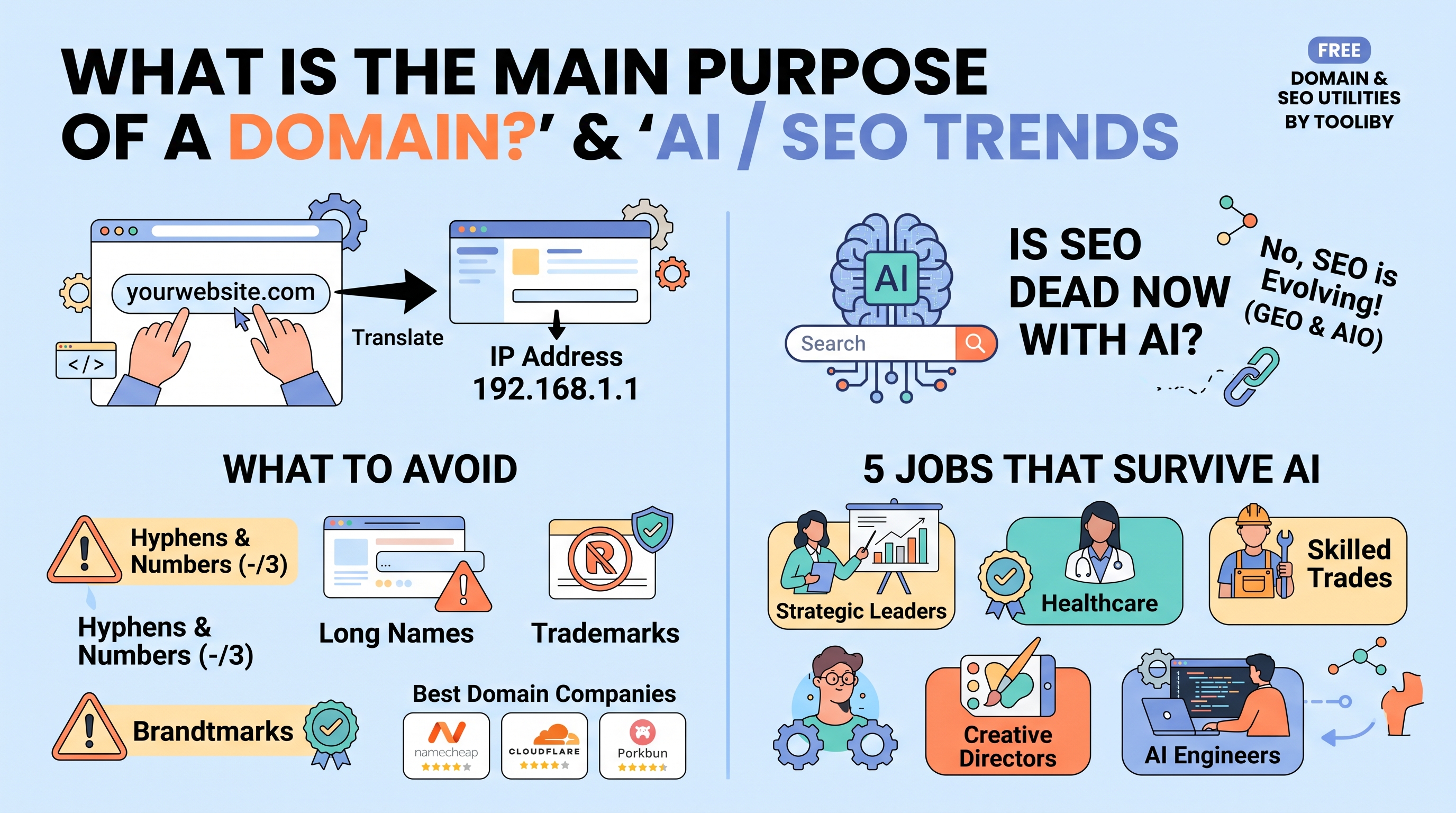
At its core, the main purpose of a domain name is to provide a human-readable address for your website.
Every website on the internet is hosted on a server identified by a complex string of numbers known as an IP address (e.g., 192.168.1.1). Because humans cannot easily memorize long sequences of numbers, the Domain Name System (DNS) was created to translate those numbers into memorable, brandable text (e.g., yourwebsite.com).
Why would someone need a domain?
Beyond mere technical navigation, you need a domain to establish brand ownership, build professional credibility (e.g., custom email addresses like contact@yourwebsite.com), and maintain control over your digital footprint. Without your own domain, you are simply renting space on someone else's platform.
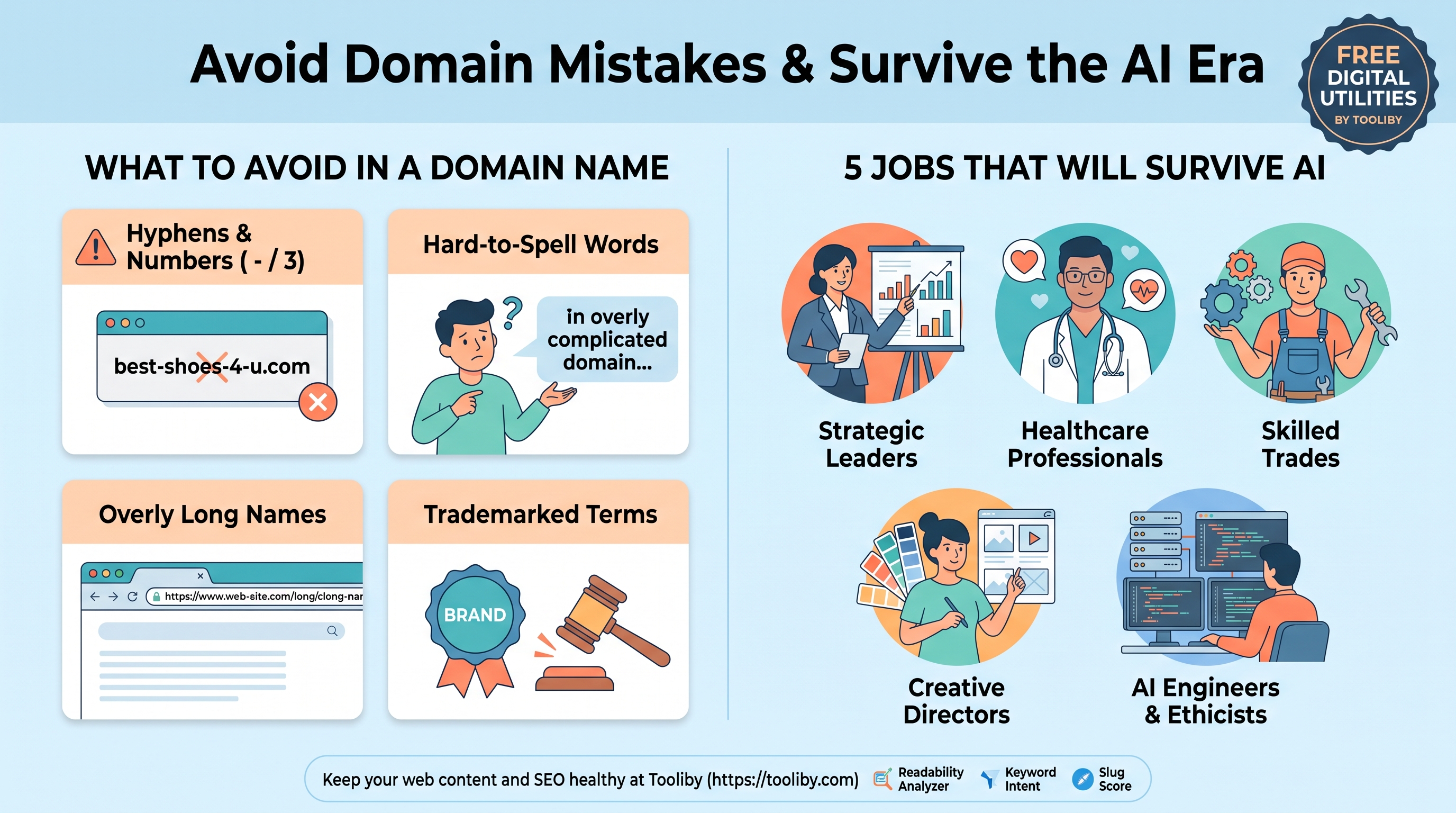
Choosing a domain is a long-term commitment. A poor naming choice can confuse users and hurt your brand. When brainstorming, you must avoid the following common mistakes:
Hyphens and Numbers: Avoid domains like
best-shoes-4-u.com. They look spammy, are difficult to communicate verbally, and users frequently forget to type the dashes.Hard-to-Spell Words: If you have to spell out your domain name every time you say it aloud, it is too complicated. Keep it phonetically simple.
Overly Long Names: The best domains are short and punchy. Aim for under 15 characters.
Trademarked Terms: Never include trademarked names (like "Facebook" or "Google") in your domain, or you risk facing severe legal action and losing your website.
When deciding where to register your digital real estate, you want a company with transparent pricing and strong security.
Who is the best domain company? While "best" is subjective, top industry leaders include Namecheap (best for budget and transparency), Cloudflare (best for at-cost renewals and security), and Porkbun (great customer service and clean interface).
Which domain is in demand? The classic
.comextension remains the undisputed king of domains, holding the highest trust among everyday users. However, in recent years, the.ai(Artificial Intelligence) and.io(Tech/Startups) extensions have seen massive surges in demand due to the booming tech industry.
Once your domain is registered, the next step is getting people to visit it. But with tools like ChatGPT and Google's AI Overviews summarizing answers instantly, a major question has emerged: Is SEO dead now with AI?
No, SEO is not dead—but it is fundamentally evolving.
The old era of SEO, which relied on stuffing keywords into articles and writing robotic content for search engines, is completely dead.
What is replacing SEO? Traditional SEO is making way for GEO (Generative Engine Optimization) and AIO (Artificial Intelligence Optimization). AI search engines want to surface content that demonstrates real human experience, unique data, and deep expertise. Instead of trying to "trick" the algorithm, the new strategy involves creating highly engaging, human-centric content that AI models use as trusted reference citations.
The shift toward AI isn't just changing how websites rank; it is reshaping the global workforce. While AI excels at data processing and repetitive coding, it lacks emotional intelligence, physical dexterity, and complex strategic reasoning.
Here are 5 jobs that are highly likely to survive and thrive alongside AI:
Strategic Business Leaders: AI can analyze data, but deciding when and where a company should pivot requires human intuition, risk assessment, and leadership.
Healthcare Professionals & Therapists: Medicine involves empathy, physical touch, and complex human interactions that no robot can replicate.
Skilled Trades (Electricians, Plumbers): Physical world problem-solving in unpredictable environments remains entirely out of reach for software-based AI.
Creative Directors: AI can generate images and text based on prompts, but defining the creative vision, cultural relevance, and overarching brand story requires a human director.
Advanced AI Engineers & Ethicists: Someone has to build, maintain, secure, and regulate the AI models themselves.
As search engines shift toward rewarding human readability and high-intent content, you must ensure your website is perfectly optimized. Audit and polish your domain's content using
Write for Humans, Not Bots: AI engines prefer clear, easily digestible text. Test your content's flow with the
Tooliby Readability Analyzer Match User Intent: Ensure your articles directly answer what users actually want by checking the
Keyword Intent Analyzer Craft Clickable Titles: Competing in AI search requires titles that evoke curiosity. Evaluate your headlines with the
Title Emotion Analyzer Create Clean URLs: Make sure your domain's individual page links are clean and SEO-friendly using the
Slug Score Checker
1. Why would someone need a domain if they have a social media page?
Social media platforms own your audience and can change their algorithms or ban your account overnight. A domain gives you 100% control and ownership of your digital presence.
2. Is a .net or .org domain as good as a .com?
While .com is the most recognized, .org is highly trusted for non-profits and communities, and .net is a solid alternative for tech and networking sites.
3. Will AI completely replace Google Search?
No, but it will change it. People will still search for specific websites, brands, and real-time news, but AI will provide instant answers for basic factual queries.
Secure your domain, focus on real human experience, and keep your web content flawless by exploring the 360+ Free Digital Tools at
What Is Tooliby Blog?
Tooliby Blog is a free publication covering developer tools, SEO, AI prompts and productivity — written by real practitioners who use these tools daily. No paywall, no account needed. Just practical content you can act on.
Can I share this article?
Yes — use the share buttons above to post on Twitter, LinkedIn, Facebook or WhatsApp. The more people read it, the better.
How do I write for Tooliby?
Click Write for Us and submit your article. We review within 48 hours and publish with full author credit and bio.