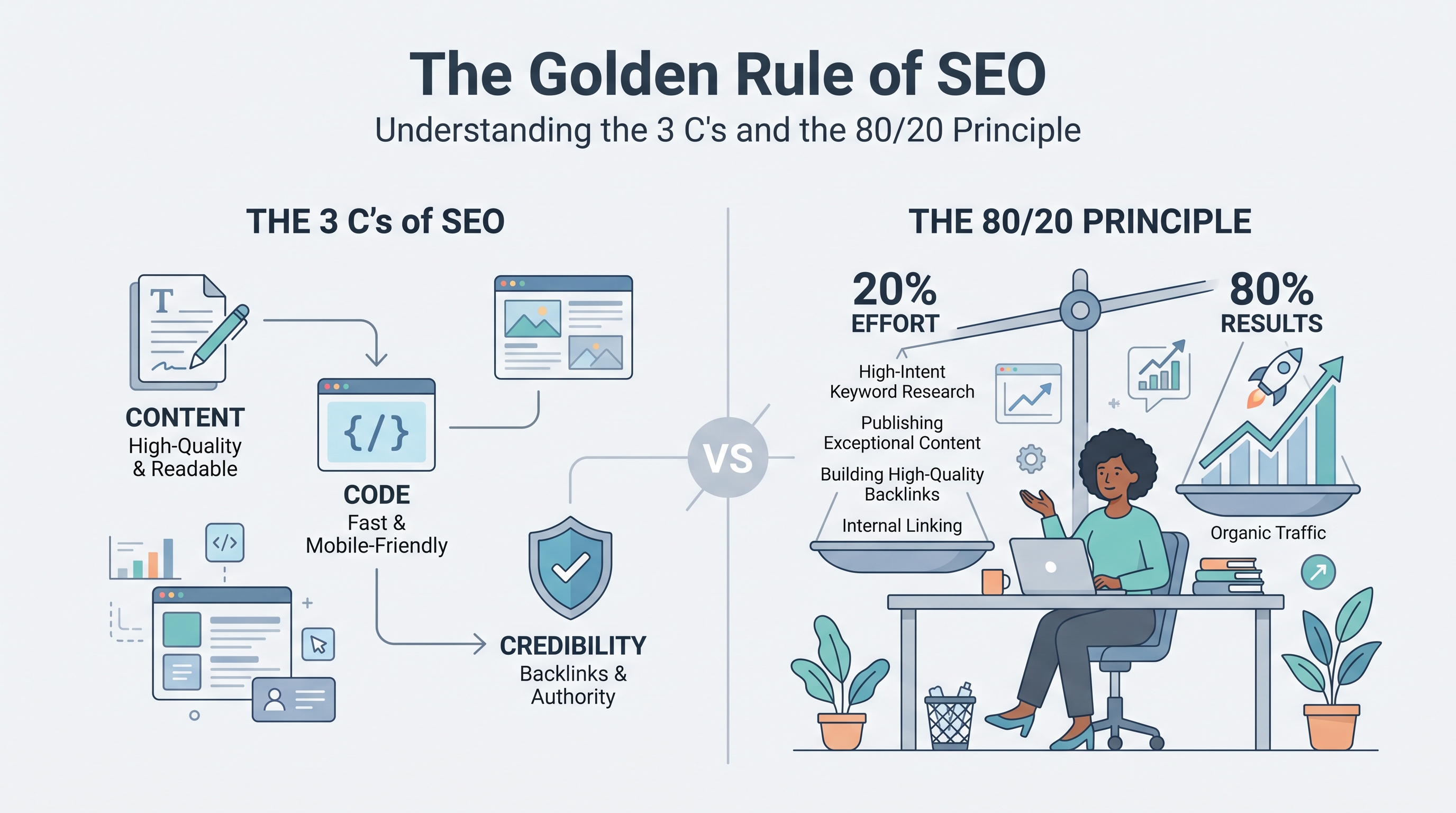
The Golden Rule of SEO: Understanding the 3 C's and the 80/20 Principle
Are you feeling overwhelmed by the endless list of ranking factors, algorithm updates, and technical jargon in 2026? It is easy to get lost in the details and forget the bigger picture.
The core answer: The golden rule of SEO is simple—"Write for humans, but structure for bots." To achieve this without burning out, successful marketers rely on two foundational concepts: the 3 C's of SEO and the 80/20 Pareto Principle.
By understanding these frameworks, you can stop wasting time on micro-optimizations that do not matter and focus strictly on what drives real organic traffic. Here is your complete guide to mastering the ultimate SEO mindset.
Table of Contents
What is the Golden Rule of SEO?
If you ask ten different experts what the "Golden Rule" of SEO is, you might get ten different technical answers. However, the true, evergreen golden rule that survives every Google Core Update is this: Solve the user's problem faster and better than anyone else on the internet.
Google's entire business model relies on serving the most helpful, accurate, and readable content to its users. If your website focuses purely on tricking search engines with keyword stuffing or shady link-building, your rankings will eventually crash. Prioritize the human experience first, and search engine visibility will follow.
The 3 C's of SEO Explained
To apply the golden rule practically, you need to master the 3 C's of SEO. These three pillars represent the core foundation of any successful website.
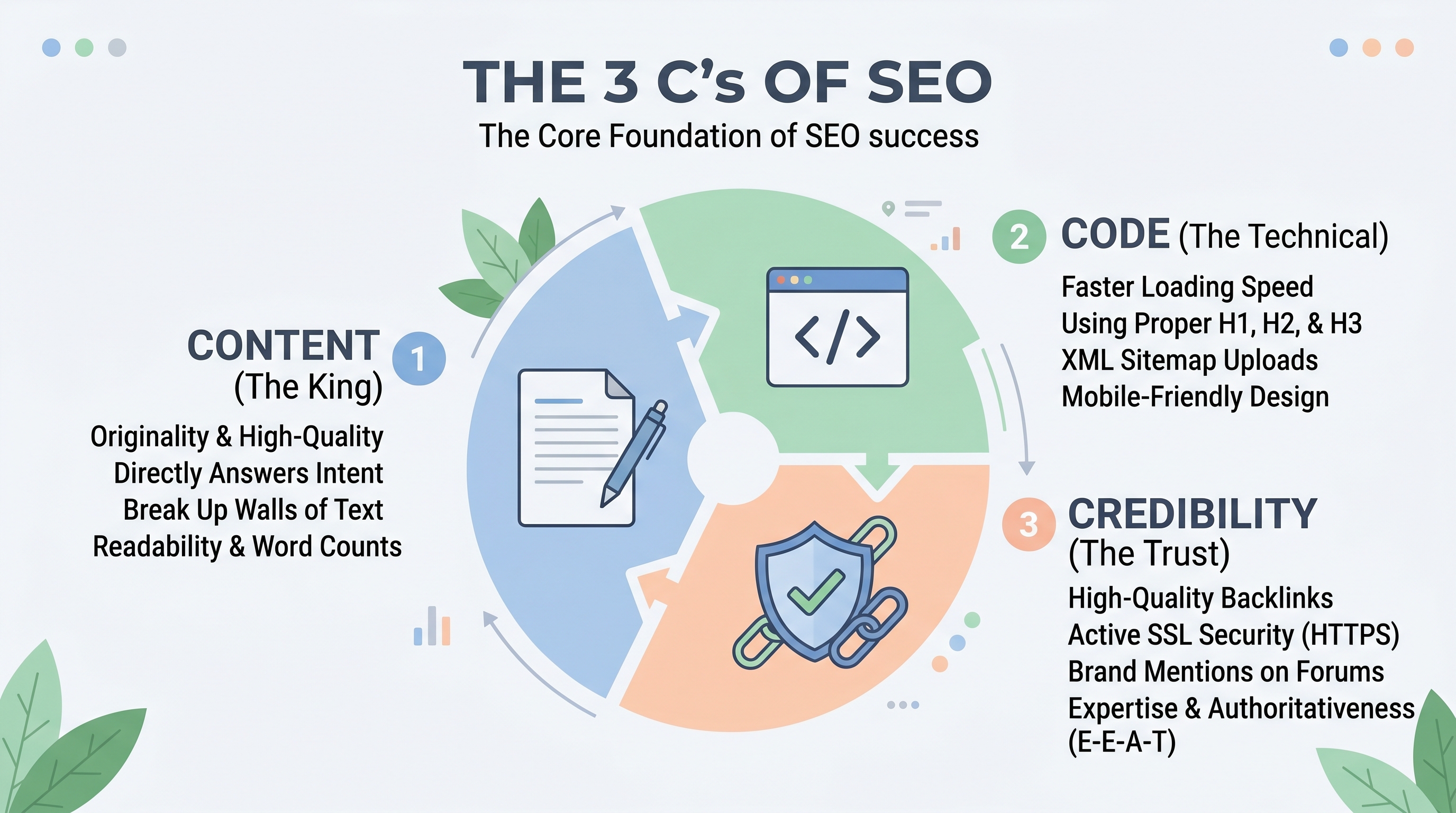
1. Content (The King)
Content is the reason people visit your website. Without high-quality, relevant content, you have nothing to optimize.
Originality: Does your post offer new insights, or is it just a copy of existing articles?
Intent: Does it directly answer the specific question the user searched for?
Readability: Break long walls of text into short paragraphs and bullet points. (Tip: Use a free
Word Counter & Readability Tool
2. Code (The Technical Foundation)
Even the best content will fail if search engines cannot read it. "Code" refers to Technical SEO and on-page structure.
Speed: Does your website load in under 3 seconds?
Structure: Are you using proper H1, H2, and H3 tags? Is your HTML clean? (You can easily clean up messy backend code using a free
HTML Minifier Mobile-Friendliness: Over 60% of searches happen on mobile devices. Your site must adapt perfectly to small screens.
3. Credibility (The Trust Factor)
Credibility (or Authority) is how Google knows your site is trustworthy. This heavily aligns with Google’s E-E-A-T guidelines (Experience, Expertise, Authoritativeness, and Trustworthiness).
Backlinks: Are other high-quality websites linking to your content?
Brand Mentions: Are people talking about your platform on social media or forums?
Security: Ensure your site has an active SSL certificate (HTTPS).
Applying the 80/20 Principle to SEO
The 80/20 Principle, also known as the Pareto Principle, states that 80% of your results come from just 20% of your efforts.
In the SEO world, beginners often waste 80% of their time on tasks that barely move the needle—like agonizing over a 1% keyword density difference, compressing an image by an extra 5 kilobytes, or changing a meta title ten times a week.
The 20% of SEO efforts that drive 80% of your traffic:
High-Intent Keyword Research: Finding exactly what your audience is asking (like specific developer errors or DIY guides).
Publishing Exceptional Content: Writing comprehensive guides that keep users engaged on the page.
Building High-Quality Backlinks: Earning 5 links from respected industry blogs is better than buying 500 spam links.
Internal Linking: Connecting your new posts to your older, established pages to pass on "link juice."
Stop obsessing over micro-metrics. Focus heavily on creating high-value content and maintaining a clean technical site.
How to Combine the 3 C's and 80/20 Rule
When you merge these two frameworks, you get a highly efficient SEO strategy:
Spend 20% of your time ensuring your Code is clean and your site is crawlable using free SEO utilities.
Spend 80% of your time building amazing Content and establishing Credibility.
By filtering out the noise and sticking to this simple roadmap, you can consistently grow your organic traffic without needing an expensive agency.
Frequently Asked Questions (FAQs)
1. What are the 3 C's of SEO?
The 3 C's stand for Content (high-quality, relevant information), Code (technical website structure and speed), and Credibility (backlinks, authority, and E-E-A-T signals).
2. What is the 80/20 rule for SEO?
It means that 80% of your organic search traffic will come from 20% of your most impactful SEO tasks—specifically keyword research, high-quality content creation, and earning credible backlinks.
3. Can you overdo SEO?
Yes. Over-optimizing your site by keyword stuffing, buying cheap backlinks, or hiding text is considered "Black Hat SEO." This violates the golden rule of writing for humans and can lead to a severe Google penalty.
Conclusion: Work Smarter, Not Harder
SEO does not have to be a complicated puzzle. By understanding the Golden Rule of SEO, mastering the 3 C's (Content, Code, and Credibility), and applying the 80/20 principle to your workflow, you can dominate search results in 2026.
Focus on what truly matters: providing an exceptional user experience and building a trustworthy brand.
Ready to streamline your 20% effort for maximum results? Check out our
What Is Tooliby Blog?
Tooliby Blog is a free publication covering developer tools, SEO, AI prompts and productivity — written by real practitioners who use these tools daily. No paywall, no account needed. Just practical content you can act on.
Can I share this article?
Yes — use the share buttons above to post on Twitter, LinkedIn, Facebook or WhatsApp. The more people read it, the better.
How do I write for Tooliby?
Click Write for Us and submit your article. We review within 48 hours and publish with full author credit and bio.