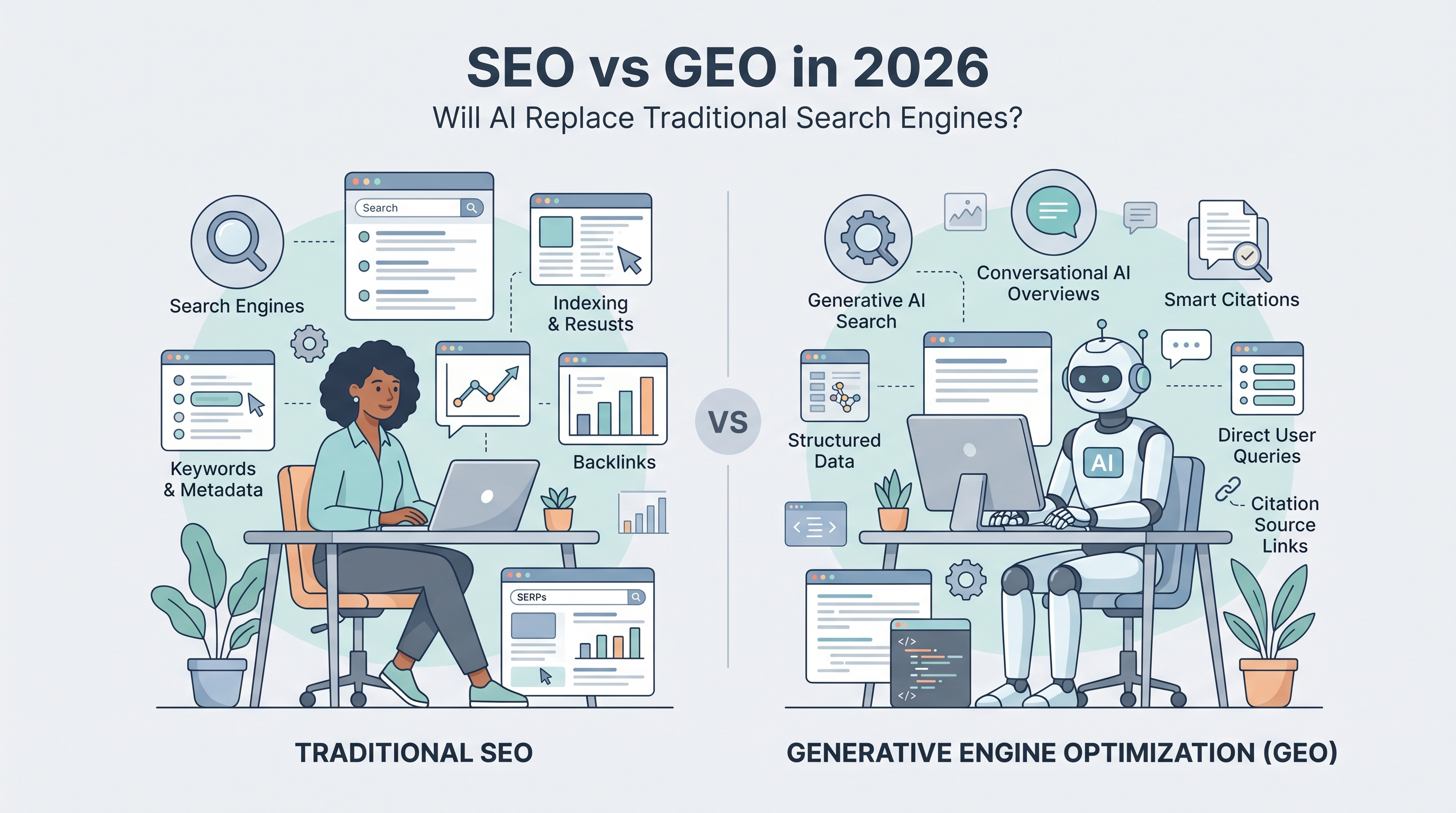
SEO vs GEO in 2026: Will AI Replace Traditional Search Engines?
Are you worried about ChatGPT, Claude, and Google AI Overviews stealing your website traffic? You are not alone. With the rapid evolution of artificial intelligence, webmasters worldwide are asking if traditional search is finally dead.
When discussing the future of digital marketing and organic traffic, the debate of SEO vs GEO (Generative Engine Optimization) is everywhere.
The short answer: No, AI will not replace SEO. However, traditional search is evolving into GEO. Instead of just ranking in a list of blue links, the new goal for websites is to be directly cited as a trusted source inside AI-generated answers.
Table of Contents
What is the Difference Between SEO and GEO?
To understand the future of search traffic, you need to understand how these two optimization methods differ.
Traditional SEO (Search Engine Optimization)
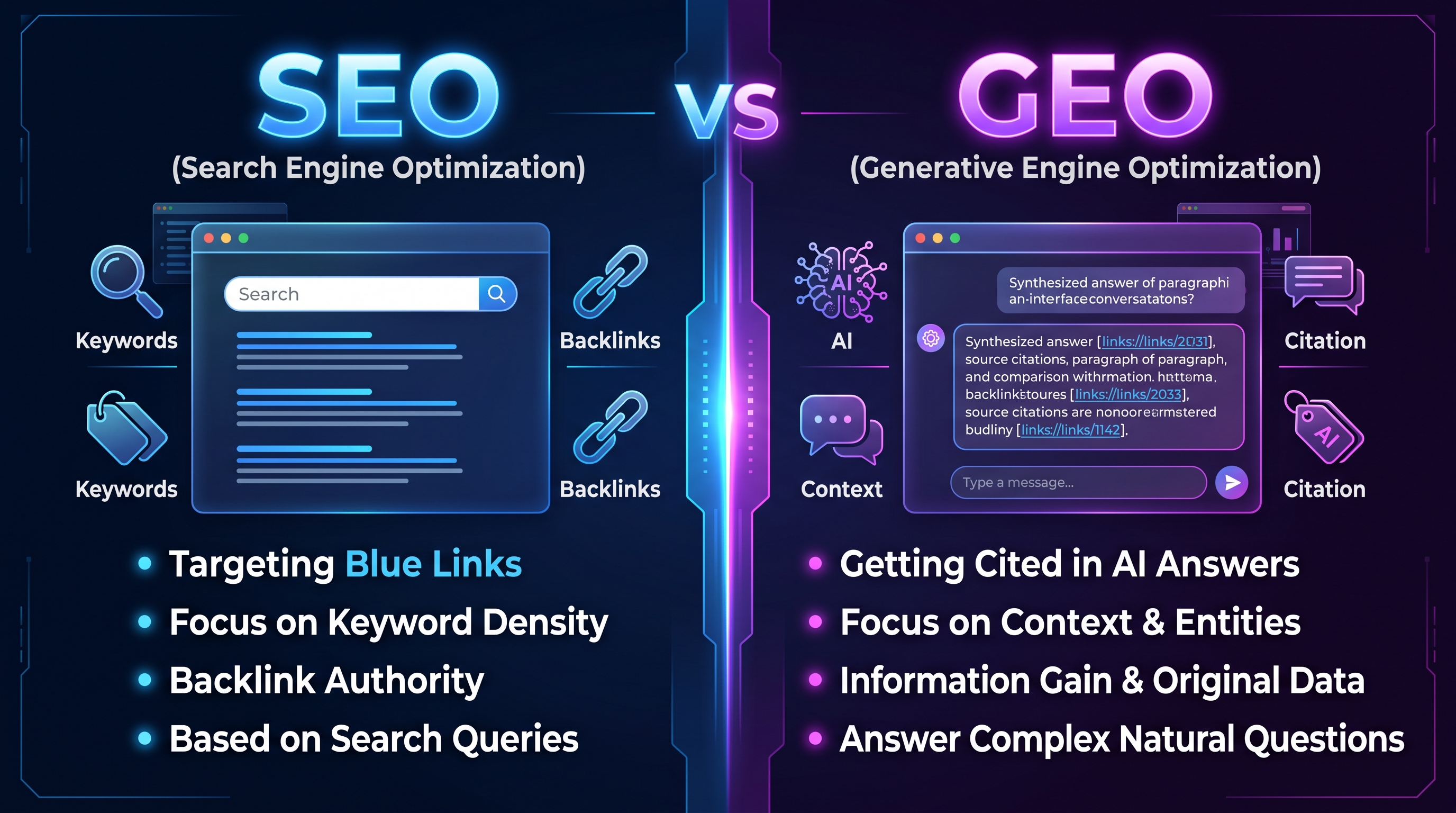
Traditional SEO focuses on ranking web pages on Search Engine Results Pages (SERPs).
It relies heavily on exact keyword density.
It measures success by backlink authority and domain age.
The primary goal is to get users to click a "blue link."
GEO (Generative Engine Optimization)
GEO focuses on optimizing your content for Large Language Models (LLMs) and AI search engines.
It relies on context, entity relationships, and conversational language.
It measures success by "Information Gain" (original data and unique value).
The primary goal is getting a "Citation Badge" within an AI's response.
Will AI Chatbots Replace Search Engines?
Many people predict that AI chatbots will entirely kill traditional search engines. However, real-world data shows a different reality. AI is changing the format of the results, not the user's intent.
Users still need to buy physical products, format data, and use interactive online utilities. AI models cannot run a live network ping test, split a PDF, or calculate local taxes—they must link out to utility websites. If your website offers real, interactive value (like free online tools), AI engines will become your new best friend, driving highly targeted traffic to your site.
How to Adapt Your Website for Google AI Overviews
If you want to maintain your traffic and master SEO in 2026, you need to shift your strategy to please both traditional crawlers and AI models. Here are three steps to do it:
1. Target Conversational, Problem-Solving Queries
AI search users do not type robotic keywords. They speak full questions, such as, "How do I compress a PDF to under 200KB for a job application?" Your content must answer these long-tail questions clearly and directly in the very first paragraph.
2. Focus on "Information Gain"
AI engines filter out copycat content. If your blog post says the exact same thing as 50 other websites, the AI will ignore it.
Share your own data and test results.
Build a custom tool that solves the problem instantly.
Write from personal experience.
3. Maintain Flawless Technical Health
LLMs still rely on search engine crawlers to discover content. If your technical foundation is weak, the AI cannot process your site.
Ensure your pages load in under 2.5 seconds.
Use clean HTML structures with proper H2 and H3 tags.
Keep your sitemaps and meta tags updated. (Tip: Use free web utilities like the
Tooliby XML Sitemap Generator Meta Tag Generator
The 80/20 Rule for SEO in the AI Era
The 80/20 rule (Pareto Principle) applies perfectly to the modern digital marketing landscape.
Moving forward, spend 20% of your time on traditional metrics (like basic keyword research and title tags) and 80% of your time on user experience, interactive elements, and direct problem-solving.
Stop writing filler content just to hit an arbitrary word count. Get straight to the point, provide the solution, and give the AI a clear answer to cite.
Frequently Asked Questions (FAQs)
1. Does Google penalize AI-assisted content?
No, Google does not penalize content simply because AI was used to assist in writing it. Google’s algorithms focus on quality, accuracy, and value (E-E-A-T). Content that solves user problems clearly will rank well.
2. How do I get my website cited in ChatGPT or AI Overviews?
To get cited, answer conversational questions directly in the first 2-3 sentences of your headings. Use clear HTML structures, incorporate original data, and ensure your site has a strong technical foundation.
3. Is traditional SEO a dead career in 2026?
No, traditional SEO is not dead, but it has evolved into an AI-first discipline. Technical SEO—such as fast page loading, mobile responsiveness, and indexing—is still mandatory because AI crawlers use traditional indexing pipelines.
Conclusion: The Future of Search Traffic
The debate of SEO vs GEO is not about choosing one over the other; it is about merging both. SEO is still the foundation of your website's visibility, while GEO is the future of how users consume your content. Webmasters who adapt to answering conversational questions and providing unique value will see their traffic multiply in the AI era.
What do you think about the future of search? Do you think AI Overviews are helping or hurting organic traffic? Let us know your thoughts in the comments below, and don't forget to check out our
What Is Tooliby Blog?
Tooliby Blog is a free publication covering developer tools, SEO, AI prompts and productivity — written by real practitioners who use these tools daily. No paywall, no account needed. Just practical content you can act on.
Can I share this article?
Yes — use the share buttons above to post on Twitter, LinkedIn, Facebook or WhatsApp. The more people read it, the better.
How do I write for Tooliby?
Click Write for Us and submit your article. We review within 48 hours and publish with full author credit and bio.