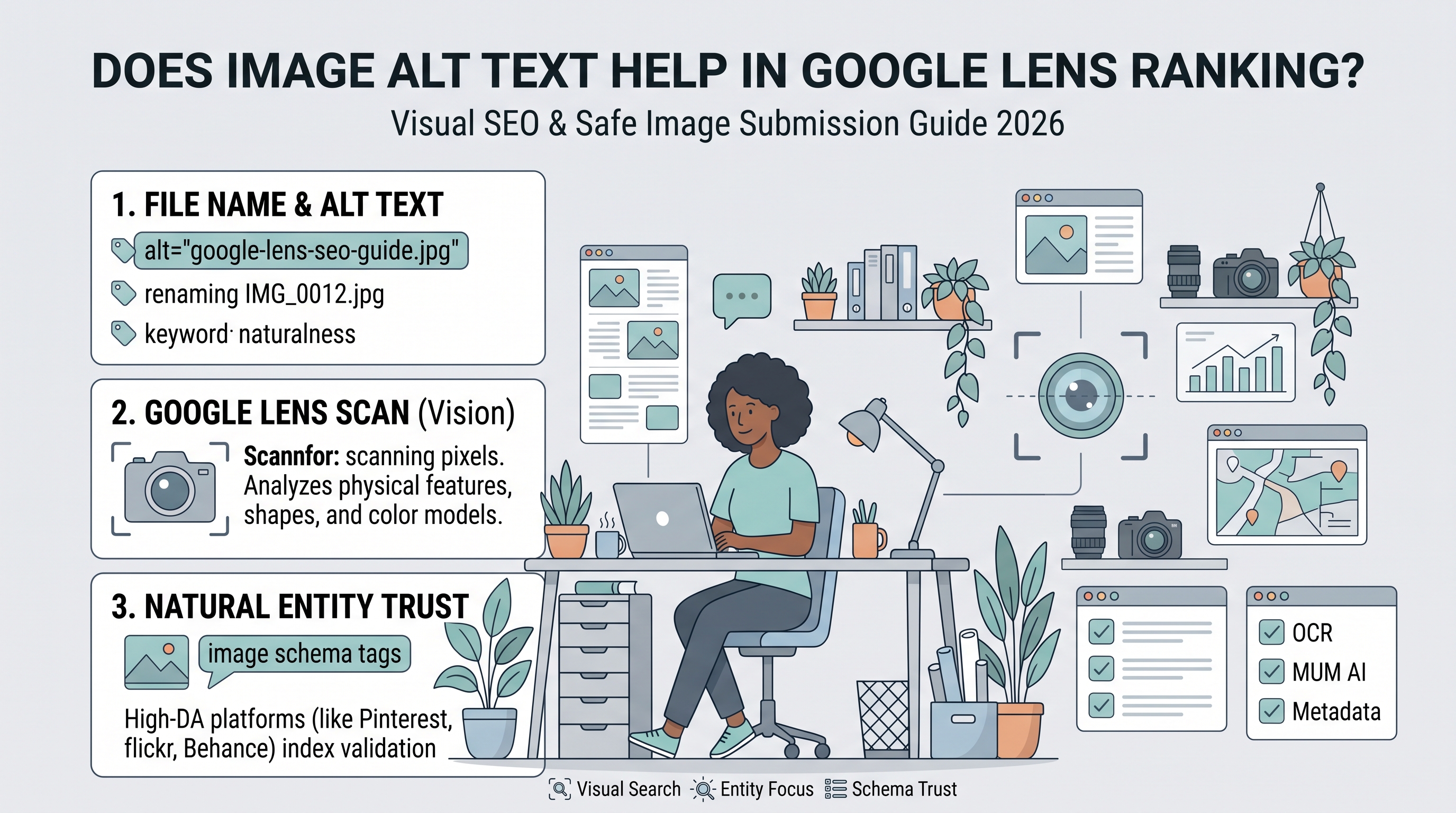
Does Image Alt Text Help in Google Lens Ranking? (Visual SEO Guide 2026)
With over 12 billion visual searches performed on Google Lens every month, Search Engine Optimization is no longer restricted to text paragraphs. Marketers and website owners are rushing to optimize their visuals for AI-driven image recognition models.
This brings up a critical question for modern SEOs: Does image alt text actually help your pictures rank on Google Lens, or does Google's AI only analyze the visual pixels?
The short answer is yes—alt text is still vital, but its role has changed dramatically.
In this guide, we will break down how Google Lens indexes image context, how alt text influences visual AI algorithms, the top high-authority visual platforms to publish your images safely, and how to optimize your images for maximum traffic in 2026.
Table of Contents
How Google Lens Indexes Images in 2026
Traditional Google Image Search relied almost entirely on text context—such as the surrounding article text, the image file name, and the HTML alt attribute.
Google Lens operates on a multimodal AI model (using Google Multimodal Multitask Unified Model / MUM technology). When a user scans an object or image using Google Lens, the algorithm performs two distinct tasks simultaneously:
Computer Vision Analysis: It identifies physical features, colors, shapes, logos, patterns, and embedded text within the image pixels.
Entity & Context Matching: It cross-references the visual scan against Google’s Knowledge Graph to verify what the image represents, using textual data across the web to confirm accuracy.
Does Alt Text Matter for Google Lens? (The Truth)
Yes, Alt Text remains a primary ranking and entity-verification signal for Google Lens.
While computer vision can recognize that an image contains a "black office chair," it cannot determine specific entity details without text signals—such as whether it is an Ergonomic Mesh Task Chair Model X2 or a Vintage Leather Executive Chair.
Here is how Alt Text directly impacts Google Lens rankings:
Disambiguation: Alt text tells Google Lens the exact brand, model, or conceptual context of a visually ambiguous image.
Search Intent Matching: When a user taps a visual result in Google Lens to view web products or source articles, Google matches the visual entity with text queries stored in the index.
Accessibility & Crawlability: Search engine spiders use Alt Text as an anchor signal to determine where the image should be categorized in visual search index tiers.
Top 15 High-DA Visual Platforms for Google Lens Indexation
Instead of uploading your graphics to 150 dead, unindexed image submission sites, focus exclusively on high-authority platforms that Google Lens crawls continuously.
| Platform Name | Domain Authority (DA) | Link Type | Google Lens Crawl Priority | Best Content Type |
| Pinterest.com | 94 | NoFollow | High (Instant) | Step-by-step visual guides & infographics |
| Flickr.com | 92 | DoFollow | High | Original high-resolution photography |
| Behance.net | 93 | DoFollow | High | UI/UX designs, branding portfolios |
| SlideShare.net | 95 | DoFollow | Very High | Document slide decks & PDF charts |
| Unsplash.com | 93 | NoFollow | Very High | High-res stock photography & branding |
| Wikimedia Commons | 95 | DoFollow | Instant (Top Tier) | Royalty-free educational diagrams |
| Tumblr.com | 86 | DoFollow | Medium | Micro-blogging cover graphics & memes |
| Dribbble.com | 92 | DoFollow | High | Vector illustrations & app interfaces |
| Issuu.com | 94 | DoFollow | High | Visual digital magazines & catalogs |
| Imgur.com | 91 | NoFollow | High | Data charts, viral graphics, memes |
| Visual.ly | 85 | DoFollow | High | High-end technical infographics |
| DeviantArt.com | 92 | DoFollow | Medium | Custom digital artwork & vectors |
| FreePik.com | 91 | NoFollow | High | Graphic design assets & mockups |
| Pexels.com | 92 | NoFollow | High | Creative photo assets |
| Scoop.it | 88 | DoFollow | Medium | Visual topic curation boards |
4-Step Blueprint to Rank on Google Lens Visual Search
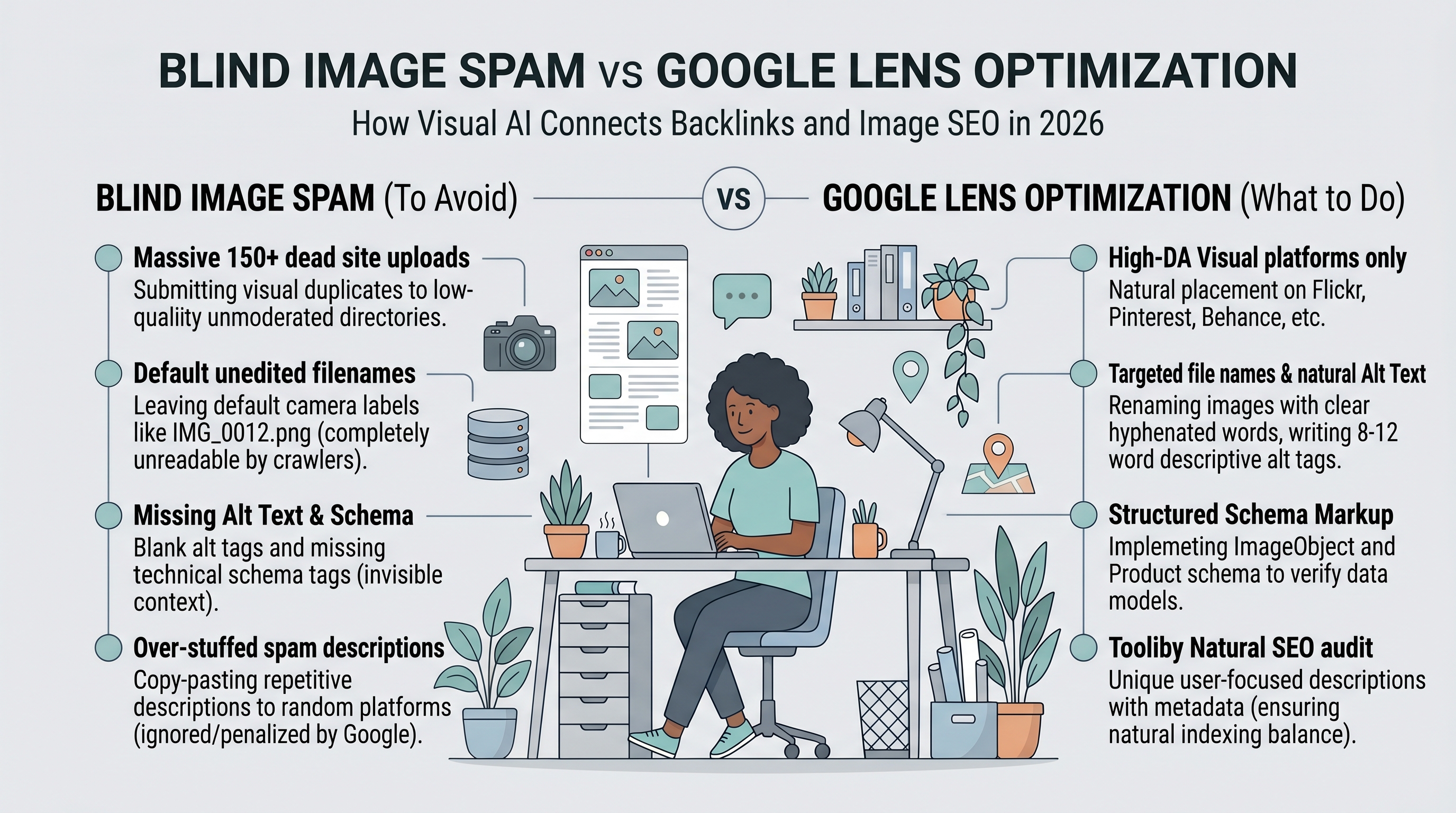
To ensure your images rank at the top of Google Lens visual search results, follow this 4-step optimization workflow:
1. Rename File Names Before Uploading
Never leave default camera strings like DCIM_0012.png. Rename the file using hyphens to describe the exact visual subject:
Bad:
image123.jpgGood:
google-lens-alt-text-seo-guide.jpg
2. Write Contextual Alt Text (No Keyword Stuffing)
Write a clear, natural description of the visual asset in 8 to 12 words. Describe what is visually present in the picture while naturally incorporating your secondary keyword.
3. Add Structured Schema Markup
Use ImageObject schema or Product schema on your web page. Providing structured JSON-LD data alongside your image guarantees that Google Lens displays pricing, availability, and author credits directly on visual overlays.
4. Embed Images Near Relevant Body Copy
Never float an isolated image at the bottom of a page without context. Google Lens evaluates the 50 words surrounding an embedded image to verify relevancy.
How Tooliby Helps Optimize Your Visual SEO
Optimizing images for visual AI requires clean metadata, well-proportioned keyword density in captions, and properly formatted image URLs. You can handle your entire Visual SEO workflow for free using
Audit Alt Text Keyword Density: Avoid keyword stuffing in your image captions and alt tags. Run your descriptions through the
Tooliby Keyword Density Checker Format External Image URLs: Sharing image links across Web 2.0 and document platforms? Clean special characters and parameter strings using the
Tooliby URL Encoder/Decoder Draft Clean Snippet Titles: Generate catchy meta tags for your infographic landing pages with the
Tooliby Meta Tag Generator
Frequently Asked Questions (FAQs)
1. Does Google Lens read text inside images?
Yes. Google Lens incorporates Optical Character Recognition (OCR). It can read, translate, and index any readable text, font, or logo rendered directly inside an image or infographic.
2. Is Alt Text more important than computer vision for Google Lens?
They work together. Computer vision identifies what the object looks like, while Alt Text tells Google why the object is relevant to a specific user search intent.
3. Do NoFollow image submission sites help SEO?
Yes. Platforms like Pinterest use NoFollow links, but they drive massive social signals, referral traffic, and instant Google Lens indexing for your visual assets.
Conclusion: Combining Visuals with Text Signals
In 2026, ranking on Google Lens requires a dual approach: high-quality original visuals for AI computer vision, paired with descriptive Alt Text and metadata for contextual verification.
By focusing on top-tier visual platforms like Pinterest, Flickr, SlideShare, and Behance, you can build authority and drive continuous visual search traffic to your domain.
Prepare your image metadata and audit your captions for free using the 400+ Free Online Developer & SEO Tools at
What Is Tooliby Blog?
Tooliby Blog is a free publication covering developer tools, SEO, AI prompts and productivity — written by real practitioners who use these tools daily. No paywall, no account needed. Just practical content you can act on.
Can I share this article?
Yes — use the share buttons above to post on Twitter, LinkedIn, Facebook or WhatsApp. The more people read it, the better.
How do I write for Tooliby?
Click Write for Us and submit your article. We review within 48 hours and publish with full author credit and bio.