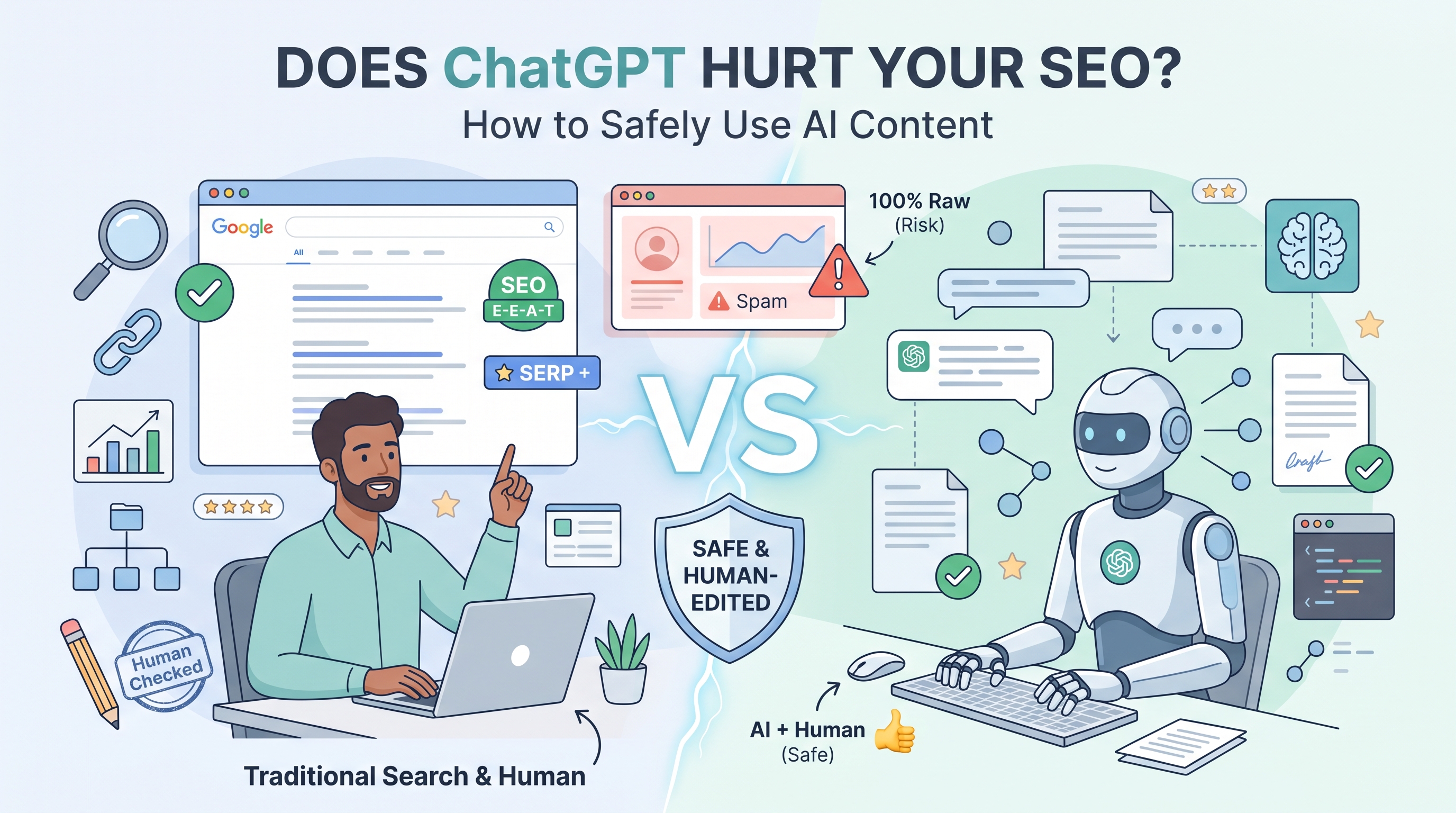
Does ChatGPT Hurt Your SEO? How to Safely Use AI Content in 2026
Are you using ChatGPT to write your blog posts and worrying if Google will penalize your website? You are not alone. As artificial intelligence becomes a staple in web development and content creation, the biggest question webmasters ask in 2026 is whether AI-generated text destroys search rankings.
The core answer: No, ChatGPT does not inherently hurt your SEO, but how you use it can. Google does not ban AI content; it bans spam, low-quality filler, and unhelpful information. If you copy-paste raw ChatGPT text without editing, your rankings will tank. However, if you use AI safely as a drafting tool, your traffic can actually grow.
Here is the ultimate guide to understanding how much AI content is acceptable in SEO and how to use it safely without risking a Google penalty.
Table of Contents
Does Google Penalize AI Content?
Let's clear up the biggest myth in digital marketing right now: Google does not have an "AI Penalty."
According to Google’s official Search Central guidelines, their ranking systems reward original, high-quality content that demonstrates qualities of E-E-A-T (Experience, Expertise, Authoritativeness, and Trustworthiness)—regardless of how it is produced.
Google’s spam algorithms are not looking for watermarks or AI patterns; they are looking for content that is purely generated to manipulate search rankings without helping the user. If your ChatGPT article solves the reader's problem, Google will rank it.
How Raw AI Content Hurts Your SEO
If Google doesn't ban AI, why do so many AI-written websites lose their organic traffic? The problem lies in raw, unedited outputs. Here is how lazy AI usage destroys your SEO:
Lack of Information Gain: ChatGPT is trained on existing data. If you ask it to write an article on "C# Database Connections," it will spit out the exact same average information that already exists on 10,000 other websites. Google ignores duplicate, low-value content.
Hallucinations & Inaccuracies: AI models confidently invent facts, broken code snippets, and fake URLs. Publishing incorrect technical data destroys your site's Authoritativeness and Trustworthiness.
Robotic Phrasing & Fluff: ChatGPT loves using repetitive transition words (e.g., "Furthermore," "In conclusion," "It is important to note"). Users bounce off your page when they read generic, robotic fluff, signaling to Google that your page is unhelpful.
Good AI vs. Bad AI Content (The Difference)
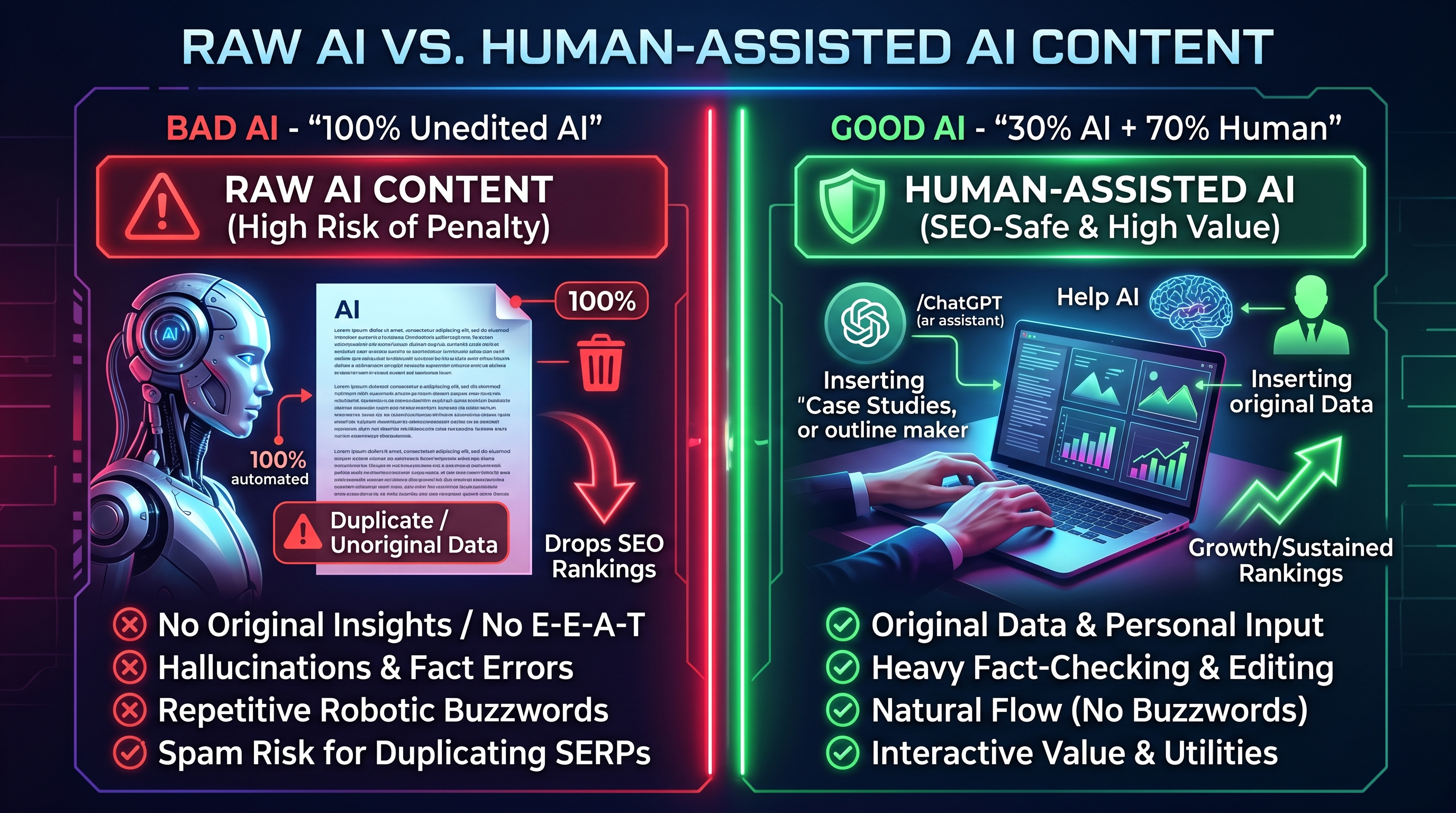
Understanding the difference between a penalized site and a ranking site comes down to human intervention.
Bad AI Content (High Risk of Penalty):
100% generated by clicking "write an article."
No personal opinions, case studies, or original data.
Formatting is just a wall of text.
No human fact-checking.
Good AI Content (Safe & SEO-Friendly):
AI used to outline and brainstorm, while a human writes the core insights.
Includes personal testing, real-life examples, and unique data.
Formatted well with bullet points, bold text, and custom images.
Proper use of technical SEO utilities. (Tip: Before publishing any AI content, ensure your technical foundation is solid. Use the
Tooliby HTML Minifier Keyword Density Checker
How to Safely Use ChatGPT for SEO in 2026
You don't have to abandon ChatGPT. Instead, use the 30% Rule for AI: Let AI do 30% of the heavy lifting (outlining, researching, summarizing), and let humans do 70% of the value creation (editing, styling, injecting expertise).
1. Use AI for Structure, Not Final Drafts
Ask ChatGPT to create an outline or a Table of Contents based on top-ranking competitors. Once the skeleton is ready, fill in the paragraphs using your own voice and experience.
2. Inject "Information Gain"
Google rewards content that brings something new to the table. If you are writing a tutorial, include custom screenshots, your own code snippets, or link to a helpful free tool like a
3. Edit for Human Readability
Always strip out robotic buzzwords. Shorten your sentences. Break up large paragraphs into easily scannable bullet points.
Is AI Writing Bad for SEO in the Long Run?
No, AI writing is not inherently bad for SEO, provided it is used as a tool rather than an author. As we move deeper into 2026, the websites that survive will be those that adopt a "Human-Driven, AI-Assisted" workflow.
If you use AI to scale your output without sacrificing your quality, your organic traffic will thrive.
Frequently Asked Questions (FAQs)
1. How much AI content is acceptable in SEO?
There is no specific percentage or limit. Google only cares about the quality of the final output. If your content is 80% AI-generated but heavily edited, fact-checked, and highly useful to the reader, it is 100% acceptable.
2. Can Google detect ChatGPT content?
Yes, Google has sophisticated systems capable of detecting AI-generated text patterns. However, detection does not equal a penalty. They only penalize the content if it is deemed unhelpful or spammy.
3. Does using an AI rewriter or paraphraser help SEO?
Usually, no. Simply spinning or paraphrasing existing content does not add "Information Gain." To rank well, you must add unique value, not just rewrite what is already out there.
Conclusion: Human-Driven, AI-Assisted
So, does ChatGPT hurt your SEO? Only if you let it run on autopilot. Copy-pasting raw AI text is a guaranteed way to lose your Google rankings. However, using ChatGPT as a high-powered assistant to outline, brainstorm, and optimize your workflow is the secret to scaling your tech blog safely in 2026.
Remember, the goal is not to trick the search engine; the goal is to help the user. Start editing your AI drafts, inject your own expertise, and watch your organic traffic soar.
Need help optimizing your newly written content? Explore our
What Is Tooliby Blog?
Tooliby Blog is a free publication covering developer tools, SEO, AI prompts and productivity — written by real practitioners who use these tools daily. No paywall, no account needed. Just practical content you can act on.
Can I share this article?
Yes — use the share buttons above to post on Twitter, LinkedIn, Facebook or WhatsApp. The more people read it, the better.
How do I write for Tooliby?
Click Write for Us and submit your article. We review within 48 hours and publish with full author credit and bio.